


MarTech Outlook: Specials Magazine
According to the Data & Marketing Association (2024 Response Rate Report), direct mail achieves a response rate of 4.4 percent, significantly higher than email’s 0.12 percent. Meanwhile, another USPS market research study found that 70 percent of consumers believe mail feels more personal than online interactions and 59 percent enjoy receiving mail from brands about new products. Direct mail is also stickier than flash-in-the-pan digital, with nearly a third of all direct mail items (31 percent) still in the home a month after delivery. Then, why isn’t direct mail used more widely? “Traditional workflows are slow, siloed and manual, requiring exported lists, third-party print vendors, design coordination and lengthy approval cycles,” explains Amber Freeman, VP of business development at PCM Integrations. “The cumbersome process doesn’t fit within the velocity of modern marketing campaigns.” PCM Integrations offers a breakthrough solution. PCM Integrations re-engineers direct mail for the digital age. Its platform-native API integrates directly with customer relationship management (CRM), e-commerce platforms and marketing automation tools to trigger real-time postcard deliveries based on live customer actions. The outreach stays in sync with every stage of the sales funnel. The automation options are endless. When a lead signs up, a welcome postcard is mailed. If a customer cancels or is a no-show, a follow-up is automatically dispatched. When a buyer goes quiet post-purchase, they receive a reactivation note or thank-you. From welcome notes to reactivation nudges, each postcard lands at the exact stage of the customer journey, reinforcing digital touchpoints with physical presence. If leads drop out of your funnel at any stage, there’s an automation ready to plug that hole and bring prospects back to purchase. And if an automation doesn’t exist, the PCM Integrations team is on hand figure out the easiest way to make the integration you need a reality. “We are all about creating an intelligent, responsive marketing engine,” adds Freeman. “We believe the most impactful message is the one you can hold in your hand, and we ensure clients achieve that with utmost speed and precision.”
Top Enterprise content strategy Service 2025
Most companies still treat content strategy as an afterthought, even though the term entered the business lexicon nearly thirty years ago. They invest in systems, finalize designs and only then plug in content. Budgets favor platforms and visuals, while the message, the part that drives real engagement, gets sidelined. Some organizations have broken that pattern. They treat content as a strategic asset from the start, shaping what is created and how it’s structured, managed and scaled. Timothy Truxell, founder and executive director of Rubicon CX, was among the first to formalize that shift. Long before content strategy had defined frameworks, he helped companies see content as a platform, something to build on, rather than a stream of disconnected outputs. “Too often, content is seen as the last river to cross, with little understanding of what’s already there or where it needs to go. We help companies cross that river and build the infrastructure to navigate it better next time,” says Truxell. At Rubicon CX, content strategy is built around three pillars: experience that ensures the content reflects the brand’s identity and speaks to user needs, delivery to make content manageable and governance for bringing consistency, accountability and long-term alignment across teams and platforms. That strategic framework has shaped content programs for the world’s most recognizable brands, including Coca-Cola, Target, Home Depot, John Deere, NASCAR and Cherokee Nation Entertainment. Whether aligning disconnected teams or streamlining operations across complex digital environments, Rubicon CX helps organizations move from content overload to content intelligence with a distinctly human touch. The Strategy Behind the Words A phased approach aligns teams, structures content and embeds governance from day one. Its fourstage model—align and research, explore and organize, structure and build and finally measure and adjust—creates a system that adapts as the business evolves.

Top Marketing Technology Solutions 2025

Micro and small businesses often rely on marketing platforms and tools chosen more for brand recognition than for true compatibility with their needs. Yet, beneath the shine of familiar names lie unused features, rigid workflows, and pricing that strains budgets without delivering the real value. That’s why strategic alignment is essential to choosing solutions tailored to their specific requirements. For leaders unsure where to begin with branding, marketing, technology, and promo products (or branded swag), Hope & Teal Designs, LLC (aka "Hope & Teal") is the answer—delivering tailored, start-to-finish solutions that amplify brand presence and operational efficiencies. Driven by faith and a passion for helping others, Hope & Teal is committed to filling the gaps in modern marketing operations with innovative solutions. It delivers on that commitment with a comprehensive suite of products and services that spans creative design, marketing automation, web and e-commerce development, and branded merchandise—all at a fraction of the cost charged by most resellers and other agencies. “This business wasn’t built to chase profit—it was built to fulfill purpose, a calling. With integrity and faith, we use our God-given talents to serve others, deliver meaningful solutions, and simplify their business,” says Cameron Marie Needham, CEO and owner. “Our commitment to quality service is grounded in our faith. I mean, after all, our company is named after my teal-bound Bible.” Hope & Teal offers a comprehensive suite of services spanning brand development, graphic design, email and SMS marketing automation, UI/UX and website design, custom development, requirements gathering and documentation, and quality assurance test management. With a customer-first mentality at its core, these services are thoughtfully integrated to build a strong foundation that supports each client’s long-term growth and success.
CXO INSIGHTS

Marketing for the new 'Digital Shelf'
Chip Schuman, Senior Vice President of Marketing, Consumer Products, Sargento Foods

Evolving Seasonal Marketing
Whitney Knight, Director, Brand Management Homewood Suites, Hilton

Direct Mail Marketing Still Has A Place in The Modern Marketing Mix
Matthew Seymour, VP of Marketing, Hyperion Materials & Technologies

Innovative Models Transforming Digital Space
Jim Lillig, Digital Marketing Director and Head of the Marketing Centre of Excellence, NSI Industries

Redefining Banking Through Purpose-driven Marketing
Janel Bazih, SVP, Head of Marketing, Spencer Savings Bank

Building Advocacy with Attendee Engagement at Your Next Event
Susan Desmond, Director, Corporate Events, Charles River Laboratories

Mastering Email Etiquette for Leaders: Crafting the Perfect Salutation
Mindy Duong, FVP Corp Content Social Media & Growth, East West Bank


IN FOCUS

The Essential Role of DMA in Modern Marketing
Once viewed as a legacy channel of traditional marketing, direct mail has undergone a significant transformation in recent years.

MarTech Reimagined: Where AI, Integration, and Strategy Converge
MarTech has evolved into an integrated, customer-centric ecosystem driven by AI, focusing on hyper-personalization and unified data strategies, enhancing marketing efficiency and consumer engagement.
EDITORIAL
Driving Growth Through Smarter Marketing
Efficiency has become a defining priority. Businesses are seeking ways to simplify operations, unify data and scale personalization without sacrificing authenticity. From automating outreach that feels human to integrating platforms for seamless decision-making and strengthening governance around messaging, marketers are dismantling silos to create engagement that is more targeted, compliant and impactful. Efficiency has emerged as a central pillar shaping the future of the marketing industry.
In this edition of MarTech Outlook, we highlight organizations transforming the marketing landscape through automated direct mail solutions, connected technology ecosystems and enterprise-ready content strategies that empower brands to grow and adapt.
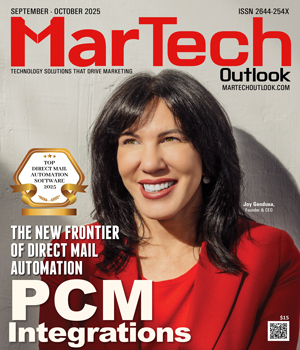
On the cover we feature PCM Integrations, a leader in direct mail automation that brings print into the digital age. Its API connects seamlessly with CRMs, e-commerce platforms and marketing tools to trigger personalized postcards in real time.
This edition also features insights from marketing leaders. Chip Schuman, Senior Vice President of Marketing, Consumer Products at Sargento Foods, underscores how rapid changes in consumer behavior have redefined the “digital shelf” and calls for marketers to remain flexible, data-fluent and open-minded. Matthew Seymour, Vice President of Marketing at Hyperion Materials & Technologies, highlights how direct mail retains a powerful role in the modern mix, emphasizing creative approaches like high-value mailers and multi-topic campaigns to qualify prospects and strengthen engagement.
We hope this edition offers fresh perspectives on the evolving marketing landscape, showing how innovation, integration and purposeful strategy are creating stronger pathways for organizations to succeed and thrive.
